Reducing Dynatrace license costs: 5 levers for lower license consumption
Why savings potential stays hidden in many Dynatrace environments and how companies can optimize their license consumption in a targeted way.

Nils Reining
Published on
Dynatrace provides valuable insight into your own IT infrastructure. But while companies monitor their applications in ever greater detail, one question often goes unanswered:
Where does your Dynatrace license consumption actually come from, and how much of it is really necessary?
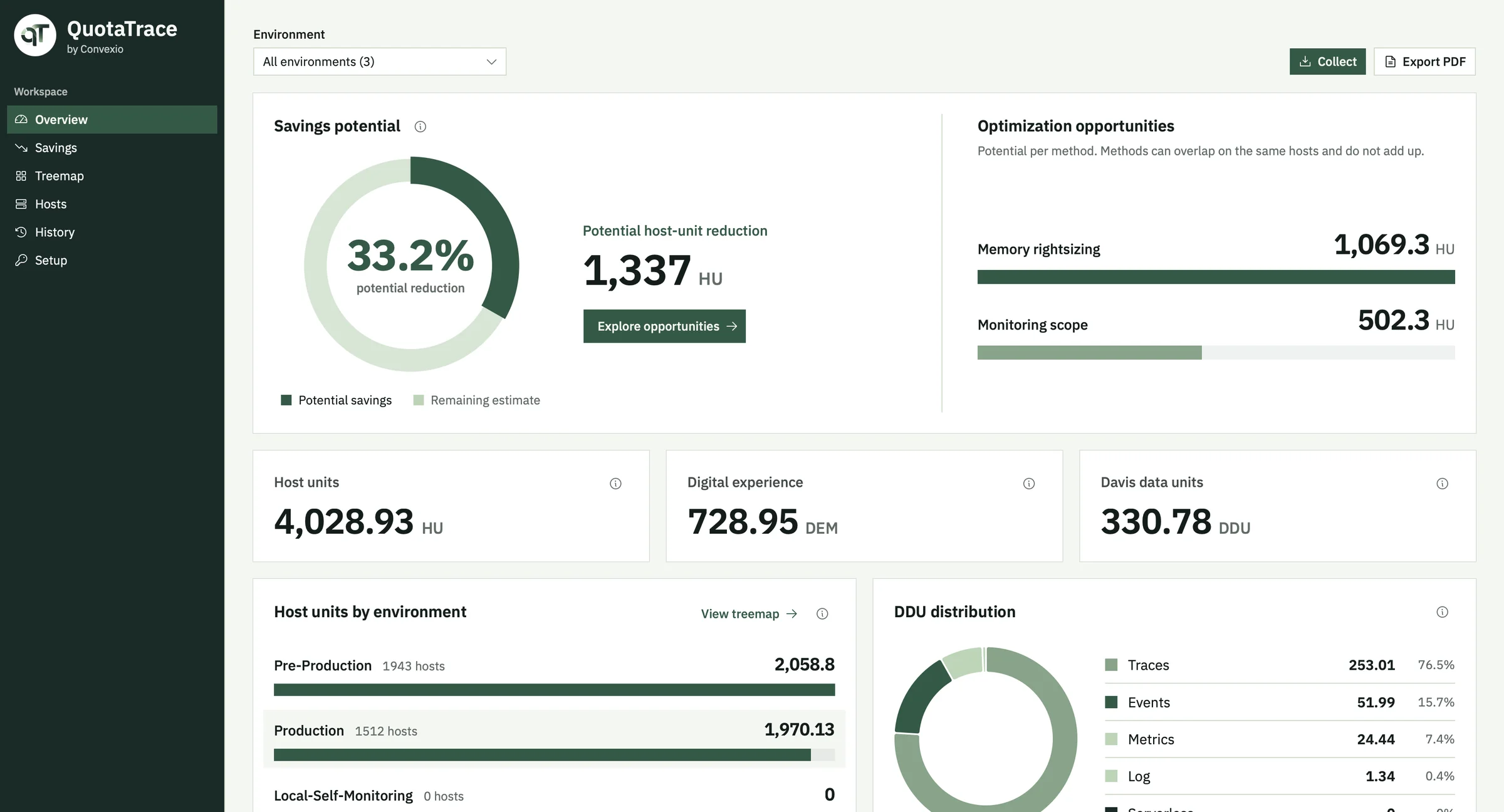
Large environments with many hosts, Kubernetes clusters and differing monitoring requirements in particular often hold considerable room for optimization. At a large, regulated German insurer, we reduced Dynatrace license consumption by about a third without giving up important monitoring capabilities.
Why high Dynatrace costs are often a transparency problem
Most companies know their annual Dynatrace spend. It gets harder when you ask which systems and configurations account for the largest share of it: Are certain hosts monitored more extensively than necessary? Which environments consume a particularly large number of license units? How is the consumption of individual Kubernetes clusters developing?
Dynatrace comes with its own features for consumption and cost analysis. In complex environments, attributing individual consumption drivers precisely still takes considerable effort. This is where real optimization begins, because knowing only the total cost does not tell you where it can sensibly be reduced.
Dynatrace Managed and SaaS: different license models, same goal
How Dynatrace license consumption is calculated depends on the license model in use.
In classic license models, Host Units (HU), Davis Data Units (DDU) and Digital Experience Monitoring Units (DEM) play a role. Host unit consumption depends, among other things, on the size of a host and the monitoring mode.
With the Dynatrace Platform Subscription (DPS), billing is consumption-based across various platform capabilities. Depending on the capability, GiB-hours or host-hours, for example, are recorded and priced according to an individual rate card. Hybrid setups combining Managed and SaaS are also possible.
Regardless of the license model: if you want to optimize your costs, you first need to understand where consumption originates. Details are available in the official Dynatrace licensing documentation.
5 levers to reduce Dynatrace license consumption
1. Identify the biggest consumption drivers
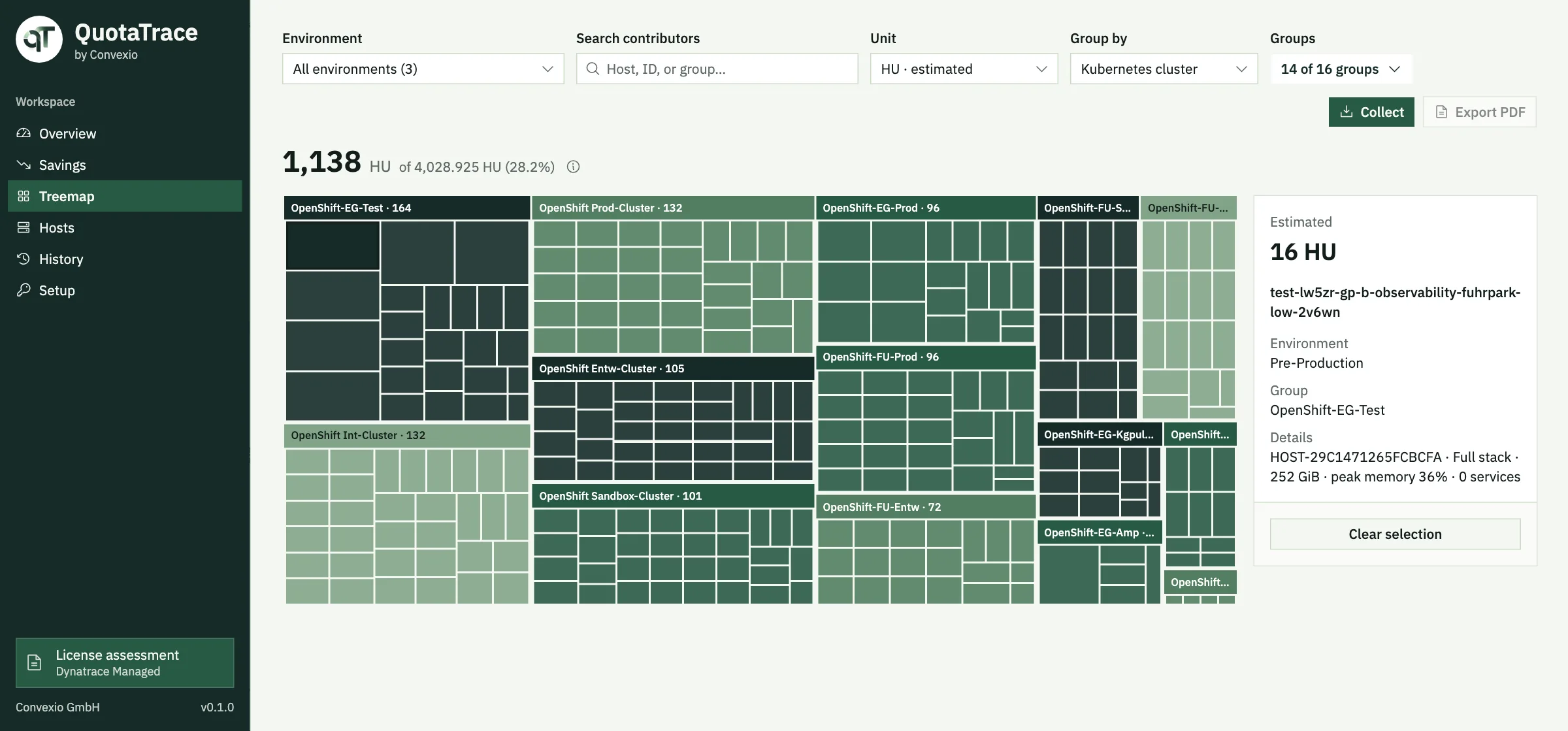
Not every host contributes equally to license consumption. Individual systems, host groups or Kubernetes clusters often account for a disproportionately large share. A detailed analysis shows which of them weigh most heavily, so optimization starts where it has the greatest effect.
2. Review monitoring modes deliberately
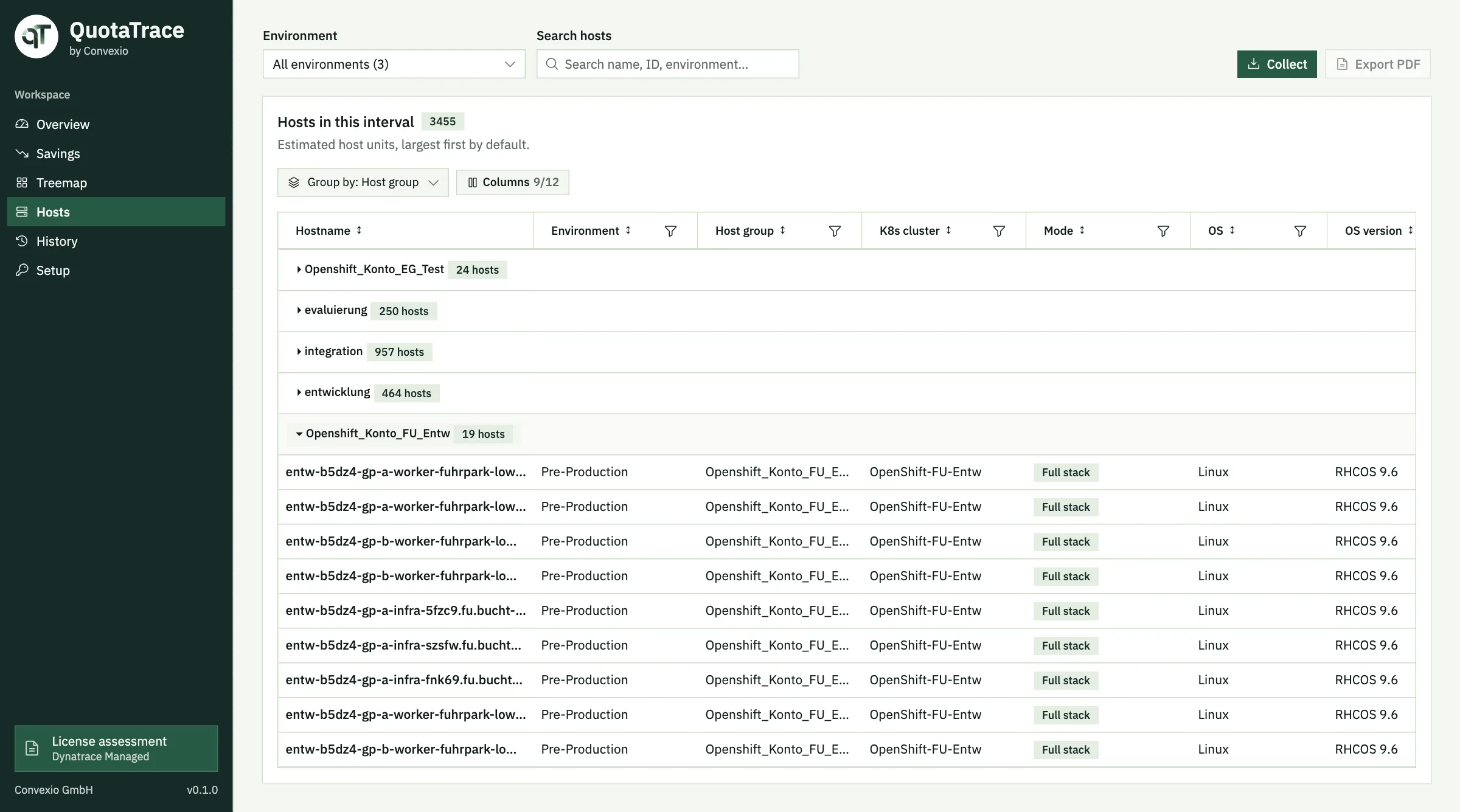
Does every host really need Full-Stack Monitoring? In many environments, systems are monitored more extensively than their requirements call for.
For certain hosts, Infrastructure Monitoring may be sufficient. The right monitoring mode lowers license consumption without losing the visibility you need. What matters is that the monitoring depth still matches the technical and operational requirements.
3. Take development and test environments into account
Development, test and staging environments can also cause considerable license consumption. It is worth checking which systems actually need continuous monitoring and whether unused resources are still generating consumption. In dynamic cloud and Kubernetes environments in particular, this is easily overlooked.
4. Examine additional data consumption
Host monitoring is not the only factor that affects costs. Depending on the license model and enabled features, additional metrics, data sources or DDU consumption are relevant as well.
A breakdown by consumption source makes unusual developments visible and helps to question unnecessary data collection. The goal is not to monitor as little as possible, but to capture exactly the information that is actually needed.
5. Keep license consumption under continuous control
A one-off optimization is a good start, but IT infrastructure keeps changing: new hosts are added, applications are migrated and monitoring configurations are adjusted. By observing license consumption over longer periods, you detect such changes early and prevent unnecessary consumption from building up again.
QuotaTrace: understanding Dynatrace license consumption down to the host level
Based on our experience with large Dynatrace environments, we at Convexio developed QuotaTrace. QuotaTrace makes Dynatrace license consumption traceable in detail and shows where optimization pays off.
The software analyzes license and consumption data from Dynatrace Managed and SaaS. Depending on the license model, it evaluates host units, DDUs and DPS consumption units, among others.
Two approaches are available:
License Assessment: A one-off analysis of the consumption data with a structured PDF report that highlights conspicuous consumers and possible areas for optimization.
Continuous Optimization: Ongoing analysis of license consumption with time series and dashboards that can be used directly in Dynatrace.
A particular advantage for companies with strict security requirements: QuotaTrace runs locally in your own infrastructure. No sensitive monitoring data has to be transferred to Convexio or external cloud services for the analysis.
Learn more about how it works on the QuotaTrace website.
How large is the actual savings potential?
At a large, regulated German insurer, we reduced Dynatrace license consumption by about 33%. With large license budgets, however, even a much smaller reduction can be economically significant.
How large the financial savings actually turn out to be depends on the license agreement, the rate card and existing commitments. Lower consumption therefore does not always translate directly into equally high cost savings. A well-founded consumption analysis provides the basis for assessing the potential realistically.
Find out how much potential your Dynatrace environment holds
Reducing Dynatrace license costs does not start with switching off monitoring, but with a better understanding of your own consumption. With QuotaTrace, we create exactly this transparency and focus on the areas where optimization really pays off.
Would you like to know what savings potential your Dynatrace environment offers?